Key points
- Every invoice: your details, the client’s, a unique number, the date, what you sold, the total and how to pay.
- Registered for VAT or GST: add your tax number and show the tax by rate.
- UK and EU VAT invoices also need the tax point (date of supply) and, for business clients in another EU country, their VAT number and a reverse-charge note.
- Australia: a sale of $82.50 or more (including GST) needs a tax invoice with your ABN; from $1,000 also the buyer’s identity or ABN.
- Canada: from $30, show your GST/HST number; from $150, also the buyer’s name, the terms and a description.
- US: no national format. Add state sales tax only where you collect it.
02What every invoice needs
- Your business name, address and contact details
- Your client’s name and address
- A unique invoice number, in sequence
- The date of the invoice
- A description of each product or service, with quantity and price
- The total amount due, and the due date
- How to pay you
03United States
There’s no federal invoice format. If you collect state or local sales tax, show it on its own line: rules differ by state, and many states don’t tax most services. Adding your EIN is optional; don’t use your Social Security number on invoices.
04United Kingdom
If you’re not VAT-registered, don’t charge VAT or show a VAT number. If you are, a full VAT invoice also needs your VAT registration number, the tax point (time of supply) if it differs from the invoice date, the price of each item before VAT, the VAT rate and the VAT amount for each rate, and the total VAT. For sales of £250 or less including VAT you can use a simplified invoice. See HMRC’s guide to VAT invoices.
A limited company must show its registered name on its invoices, and its company number, where it’s registered and its registered office address on business letters and order forms; most put all of them on invoices too.
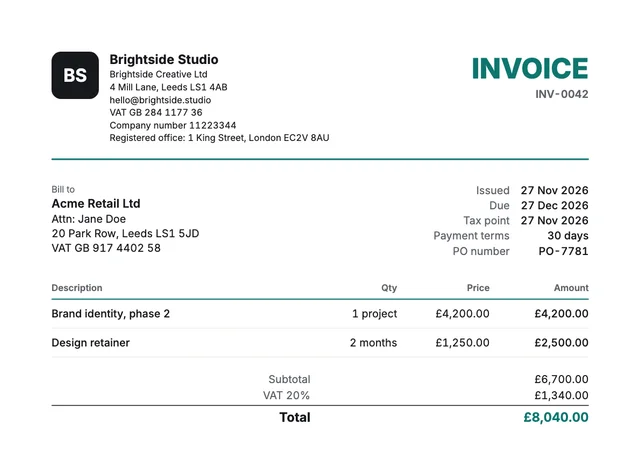
A UK VAT invoice from a limited company to a business client.
On this example- 1The registered company name (the business trades as Brightside Studio)
- 2Your VAT registration number
- 3Company number
- 4Registered office address
- 5Tax point (time of supply)
- 6The client’s VAT number
- 7VAT shown by rate
05European Union
An EU VAT invoice needs a sequential number, the date, your VAT number, names and addresses, the quantity and nature of what was supplied, the date of supply if different, the taxable amount and VAT for each rate, and the VAT rate. For a business client in another EU country, add their VAT number and a note that the reverse charge applies. Small businesses under their country’s VAT threshold add a note saying why no VAT is charged (in Germany, under §19 UStG).
Several EU countries now require e-invoices sent through official systems for business-to-business sales: Italy already does, and Germany and France are phasing it in from 2025 to 2027. A PDF invoice is still fine for sales to consumers.
06Canada
If you’re registered for GST/HST, what you show depends on the sale so your client can claim input tax credits: under $30, your business name, the date and the total; from $30 to $149.99, also your GST/HST registration number and the tax charged (or a note that it’s included); from $150, also the buyer’s name, the payment terms and a description of what was sold. See the CRA’s rules.
07Australia
If you’re registered for GST, a sale of $82.50 or more including GST needs a tax invoice: the words “Tax invoice”, your identity and ABN, the date, what you sold with its quantity and price, and the GST amount (or a statement that the total includes GST). From $1,000, also the buyer’s identity or ABN. If you’re not registered for GST, don’t call it a tax invoice, but do show your ABN: without it, a business client may have to withhold tax from your payment. See the ATO’s tax invoice rules.
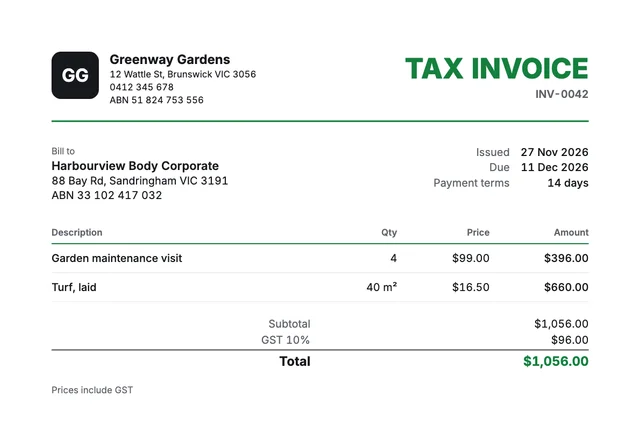
An Australian tax invoice over $1,000, with prices including GST.
On this example- 1The words “Tax invoice”
- 2Your ABN
- 3The buyer’s ABN (sales of $1,000 or more)
- 4The GST included
08Questions
Do I need to put my tax number on an invoice?
If you’re registered for VAT, GST or GST/HST, yes. If you aren’t, leave it off and don’t charge the tax. In Australia, show your ABN either way.
What is a reverse charge?
For some business-to-business sales across EU borders (and some UK construction work), the buyer accounts for the VAT instead of the seller. You don’t charge VAT, and the invoice says that the reverse charge applies and shows the buyer’s VAT number.
Does a limited company need its company number on invoices?
In the UK a company must show its registered name on invoices and its company number, place of registration and registered office on business letters and order forms; most companies include them on invoices as well.
Can I send PDF invoices in the EU?
To consumers, yes. For business clients, check your country: Italy requires e-invoices through its SDI system, and Germany and France are phasing in e-invoicing for business-to-business sales.
General information, not legal or tax advice. Rules change and depend on your situation: check with your tax authority or an accountant.