Key points
- “Net 30” means payment is due 30 days after the invoice date; “due on receipt” means now.
- Put the due date itself on the invoice, not only the terms.
- For new clients or large jobs, ask for a deposit before you start.
- UK and EU business clients who pay late owe statutory interest and a fixed compensation fee by law.
- Send invoices straight away, make paying easy, and remind before and after the due date.
02Common payment terms
| Term | Means |
|---|---|
| Due on receipt | Pay as soon as the invoice arrives |
| Net 7, Net 14, Net 30, Net 60 | Pay within 7, 14, 30 or 60 days of the invoice date |
| EOM | Pay by the end of the month the invoice is dated |
| 2/10 Net 30 | 2% off if paid within 10 days, otherwise the full amount within 30 |
| 50% upfront | Half before the work starts, the rest on completion |
03Which terms to choose
For consumers and small jobs, due on receipt or 7 days is normal. Businesses often expect 30 days, and large companies may ask for 60. Agree the terms before you start, put them on the estimate, and use the same ones on the invoice.
04On the invoice
Show the terms, the due date itself and any deposit, so nobody has to work them out.
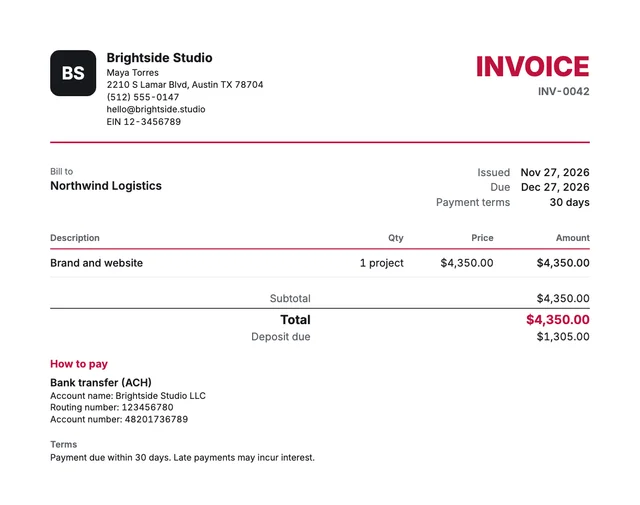
A project invoice with 30-day terms and a 30% deposit.
On this example- 1The payment terms
- 2The due date itself
- 3The deposit due now
- 4Terms, including late payment
05Late payment fees
In the UK, business clients who pay late owe statutory interest of 8% above the Bank of England base rate, plus a fixed sum of £40, £70 or £100 depending on the size of the debt (the Late Payment of Commercial Debts Act). In the EU, the Late Payment Directive sets interest of at least 8% above the ECB reference rate and €40 compensation. In the US, late fees depend on state law and your contract: put them in your terms before the work starts.
06How to get paid faster
- Invoice as soon as the work is done
- Put a clear due date on every invoice
- Make paying easy: full bank details or a payment link
- Ask for a deposit on new clients and large jobs
- Send a friendly reminder a few days before the due date, on the day, and after it
- Thank clients when they pay: it makes the next invoice easier
- 3 days beforeA friendly heads-up that the invoice is due soon
- On the due dateA reminder with the link and how to pay
- 3 days afterA polite nudge: it’s now overdue
- Every week afterUntil it’s paid, then a thank-you
07Questions
What does Net 30 mean?
Payment is due 30 days after the invoice date. On an invoice dated 1 March, the client should pay by 31 March.
Can I charge interest on a late invoice?
For business clients in the UK and the EU, yes: the law sets statutory interest and a fixed compensation fee. In the US it depends on your state and contract. Charging consumers late fees needs to be in the terms they agreed to.
When should I send a payment reminder?
A short, friendly reminder a few days before the due date, another on the day, and then weekly after it. Most late invoices are forgotten, not disputed.
Should I ask for a deposit?
For new clients, large jobs or anything where you buy materials first, yes: 25% to 50% upfront is common.
General information, not legal or tax advice. Rules change and depend on your situation: check with your tax authority or an accountant.