Key points
- Put your business details and your client’s at the top.
- Give every invoice a unique number, in sequence, and the date you issue it.
- Say when payment is due: a date, or terms such as “30 days”.
- List each product or service with its quantity, price and amount.
- Show the subtotal, any discount, each tax separately, and the total.
- Say exactly how to pay you, then send it as a PDF or a link and keep a copy.
02An example invoice
Here’s a complete invoice from a design studio to a café, made with the free invoice generator. The numbers match the steps below.
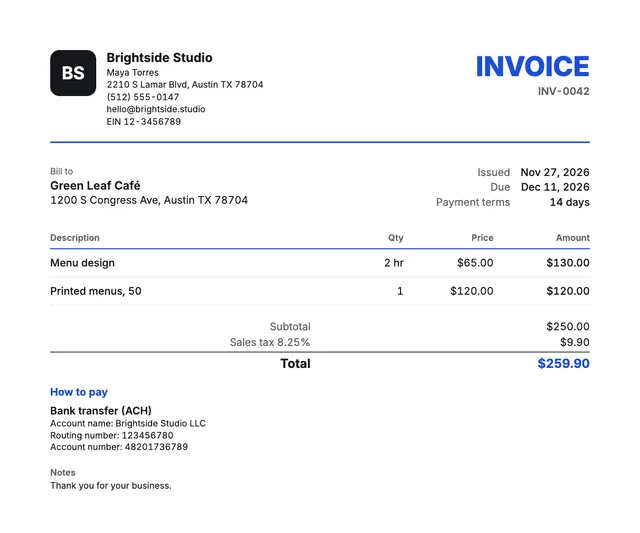
Menu design is a service, so in Texas it isn’t taxed; the printed menus are goods, so sales tax applies to them only.
On this example- 1Your business details and tax number
- 2Your client
- 3A unique invoice number and the date
- 4When payment is due
- 5Each product or service: quantity, price, amount
- 6Subtotal, tax and total
- 7How to pay you
03Your business details
Start with your business name, or your own name if you work for yourself, plus your address, email and phone. If you’re registered for a sales tax such as VAT or GST, add your tax number. A limited company also shows its registered name and company number (see what to put on an invoice).
04Your client’s details
Add the client’s name, or their company’s, and their address. For a business client, add the person to send it to and their purchase order (PO) number if they gave you one: many companies won’t pay an invoice without it.
05An invoice number and the date
Every invoice needs its own number, and most tax authorities expect them in sequence with no gaps: INV-0001, INV-0002 and so on. Add the date you issue it, and the date of the work or delivery if it’s different.
06When payment is due
Write the due date, not only “Net 30”: a date is harder to miss. Common terms are due on receipt, 7, 14 or 30 days. See payment terms explained for what each means.
07What you’re charging for
Add a line for each product or service: a short description, the quantity, the unit price, and the amount (quantity × price). Describe the work the way your client will recognise it, for example “Kitchen tap replaced, 12 May” rather than “Job 44”.
08Totals and tax
Show the subtotal, then any discount, then each tax on its own line with its rate (“VAT 20%”, “Sales tax 8.25%”), then the total. If you take a deposit, show it and the balance due. Only charge a tax you’re registered for.
09How to pay you
Give your bank details (account name and number, plus the routing number, sort code, BSB or IBAN your client’s bank needs) or a payment link. The easier it is to pay, the sooner you’re paid.
10Send it and keep a copy
Send the invoice as a PDF or a link as soon as the work is done, and keep a copy for your records: tax authorities usually ask businesses to keep them for 5 to 7 years. If it isn’t paid by the due date, send a polite reminder.
11Common mistakes
- Reusing or skipping invoice numbers
- No due date, or only “Net 30”
- Charging tax you’re not registered for, or leaving out your tax number when you are
- Vague descriptions the client’s accounts team can’t match to an order
- No payment details, so the client has to ask
12Questions
Can I write an invoice if I don’t have a company?
Yes. Sole traders and freelancers invoice in their own name or a trading name. You don’t need a company or a tax number unless you’re registered for a sales tax such as VAT or GST.
Does an invoice need a number?
Yes. Each invoice needs a unique number, and in the UK, the EU, Canada and Australia tax rules expect them to be in sequence. A simple pattern such as INV-0001, INV-0002 works.
What format should an invoice be in?
A PDF is the most common: it looks the same everywhere and can’t be edited by accident. A link to an online invoice also works, and lets the client pay or download it.
How long should I keep invoices?
Usually 5 to 7 years, depending on the country: for example, HMRC asks UK companies to keep records for 6 years, and the IRS generally 3 to 7 years. Check your own tax authority’s rule.
General information, not legal or tax advice. Rules change and depend on your situation: check with your tax authority or an accountant.